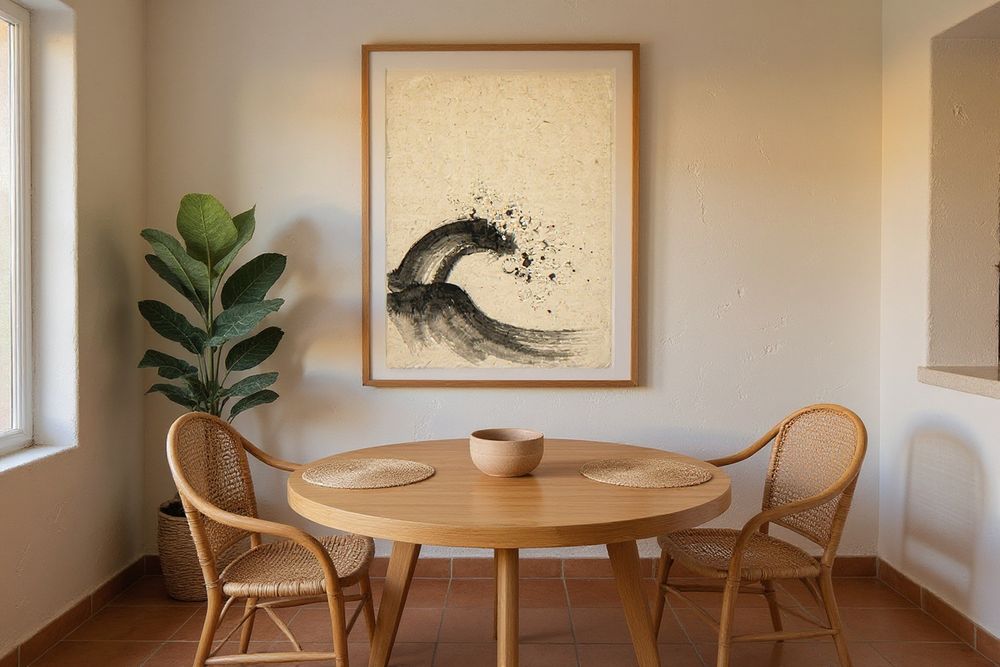
If you're drawn to minimalist wall art with an Asian aesthetic, you've probably encountered both "sumi-e" and "modern ink wash" labels. They sound similar—and they share DNA—but they're not the same thing. Understanding the difference matters when you're choosing art for your walls, especially in smaller spaces where every piece needs to earn its place.
Sumi-e (墨絵) is a centuries-old Japanese painting tradition that translates literally to "ink picture." It's rooted in Zen Buddhism and Chinese landscape painting, with strict philosophical and technical principles. A true sumi-e artist spends years mastering brush control, ink dilution, and the concept of *ma*—the power of empty space.
The hallmarks are unmistakable: monochromatic or near-monochromatic palettes, bold yet delicate brushstrokes, and compositions that suggest rather than describe. A sumi-e wave isn't photorealistic; it's the *essence* of a wave, captured in three or four confident strokes. The negative space is as important as the painted space.
Modern ink wash art borrows the *aesthetic* of sumi-e—the loose brushwork, the monochromatic feel, the zen vibe—but strips away the rigid tradition. Contemporary artists use ink washes more freely, often adding color accents, mixing styles, or combining ink with other media. It's sumi-e's rebellious younger sibling.
You'll see modern ink wash pieces that blend Japanese brush techniques with Western subjects (think surfers, sunglasses, or abstract forms), or pieces that layer ink with watercolor, charcoal, or digital elements. The philosophy is looser: the goal is visual impact and emotional resonance, not adherence to centuries of technique.
The distinction affects how a piece reads in your space. Here's what to consider:
Start by asking: What feeling do I want? If you're after calm, contemplation, and timelessness, lean toward traditional sumi-e pieces. If you want that minimalist ink aesthetic but with personality and contemporary edge, modern ink wash is your answer.
Consider your existing décor too. A sumi-e wave ink painting with its stark monochromatic brushstrokes pairs beautifully with Scandinavian or Japanese-inspired interiors. But if your space is more eclectic—maybe you have warm wood tones, some color on the walls, or a mix of styles—a sumi-e surfer print with color accents bridges the gap between zen and contemporary.
Small-space dwellers should note: both styles work, but sumi-e's negative space is your secret weapon. A single sumi-e seven waves print can anchor an entire wall without overwhelming it. Modern ink wash pieces, being slightly more detailed, pair well with other minimalist art in a gallery wall arrangement.
You don't need to be an art historian to choose between them. Think of it this way: sumi-e is the original, the meditation practice, the whisper. Modern ink wash is the conversation, the flexibility, the nod to tradition without the rules. Both are beautiful. The right choice depends on whether you want your walls to feel like a Zen temple or a creative studio.
Explore pieces like this sumi-e pelicans print or this sumi-e surfer cutback print to see how the style speaks to your space. The best wall art is the one that makes you pause and breathe a little easier every time you see it.
Ready to add some ink-wash calm to your walls? Browse RetroSwell's collection of sumi-e and modern ink wash prints—all affordable, all downloadable, all designed to fit real homes.
More on the RetroSwell Etsy shop.